T-Type Underdrain Blocks for Deep Bed Filterin Water andWastewater Aplcatbion

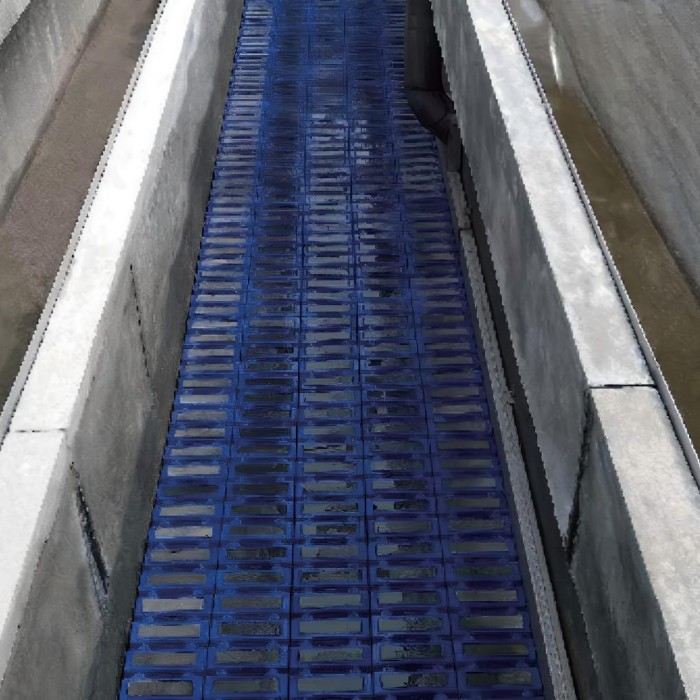
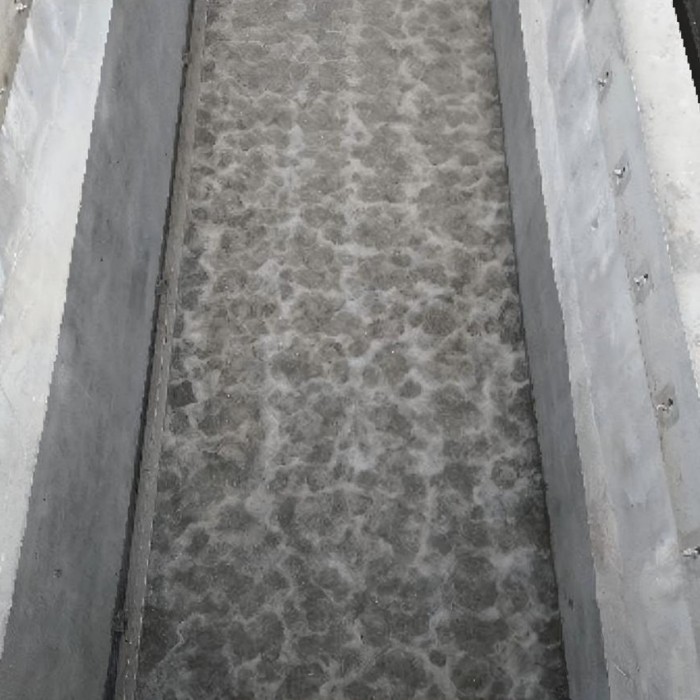
Time - Saving | Labor - Saving | Non-Clogging
As urbanization accelerates, urban wastewater discharge standards become more stringent and have been upgraded from Grade II to Grade I A in China. Both the upgrading and retrofitting of existing wastewater treatment plants and the construction of new plants with advanced treatment capabilities urgently require efficient, technologically advanced new products.
The denitrification deep bed filter is an integrated unit combining biological nitrogen removal and filtration functions. It uses specially designed large-particle-sized, thick-layer, homogeneous filter media as the biofilm support medium for denitrifying bacteria. Under conditions with added carbon sources, it functions as a denitrifying deep bed filter capable of removing total nitrogen (TN), suspended solids (SS), and total phosphorus (TP). Without added carbon sources, it operates as a deep bed filter, simultaneously removing SS and TP, thereby achieving multi-functional use and flexible operation.
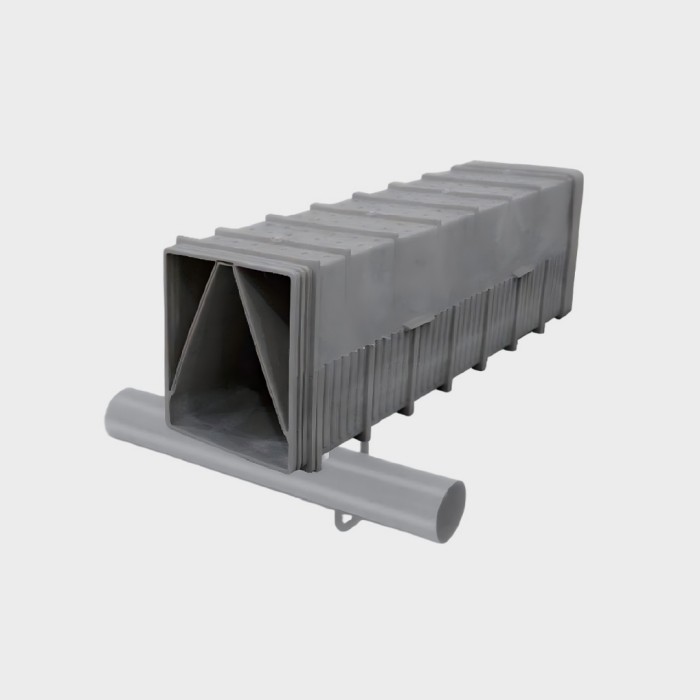
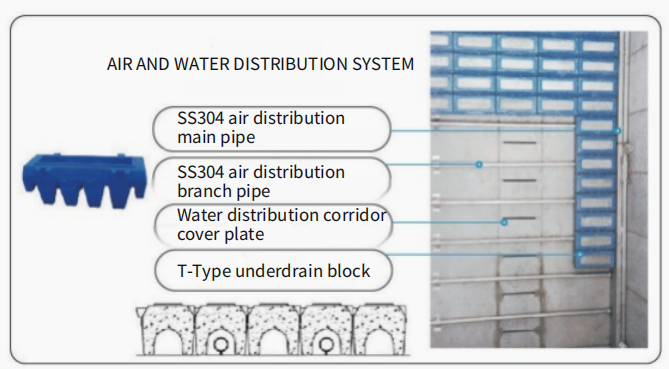
To ensure uniform air-water distribution and influential air-water backwashing, the denitrification deep bed filtration employs underdrain block design for air-water distribution. Its unique structural design creates an air reflection chamber. During backwashing, the air and water mixture and are forcefully ejected through the gaps between adjacent underdrain blocks, uniformly distributing the air and water throughout the entire filter tank area with no dead zones. Additionally, it requires no maintenance or replacement throughout its lifetime, has no wear-and-tear parts, and ensures long-term operation without any concerns.
Product Features
The shell is made of HDPE and filled with high-strength concrete with a compressive strength of 345 kgf.
Weighing at more than 24 kg each, it will not float or move.
No mortar is required for installation.
The support is solid and durable.
Installation is time-saving and labor-saving.
The opening ratio for standard design is 4%, which can be customized according to design requirements to maximize air and water distribution.
It is not easily dogged in wastewater applications.
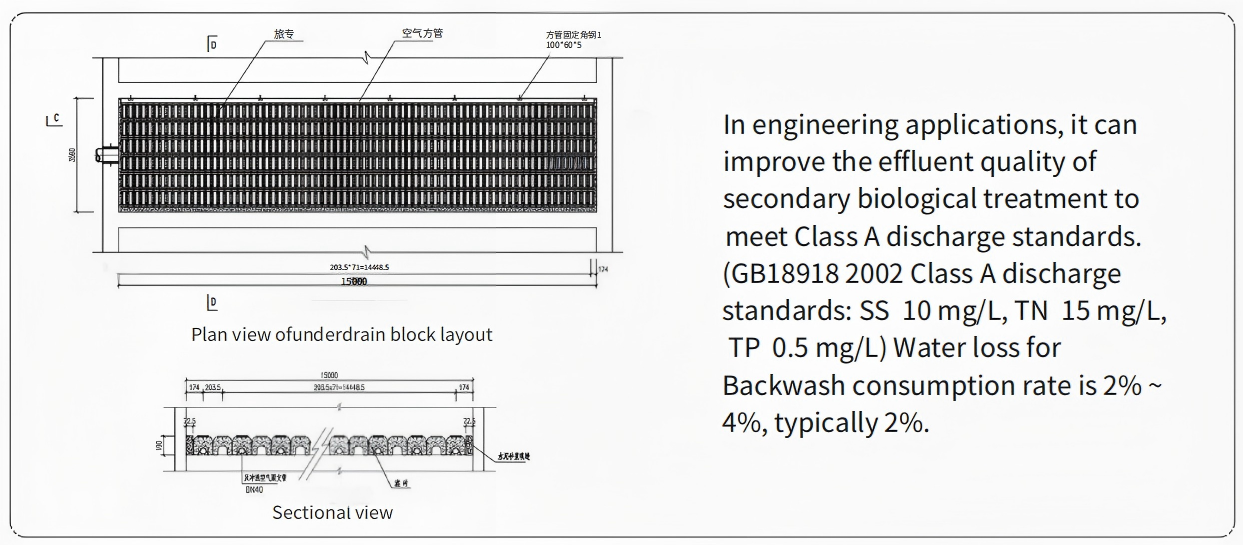
Advantages Of Underdrain Blocks
Wider range of airflow rate, 5–25 L/s·m²;
Uniform and continuous air flow to all orifices, ensuring more stable air flow distribution under all operating conditions;
Improved filter media cleaning performance: one of main characteristic of the S-type HDPE underdrain blocks is their small spacings between distribution orifices, allowing to prevent clogging by media, and enabling uniform distribution of backwash gas and water. This not only ensures trouble-free operation but also achieves efficient media cleaning results. Some underdrain blocks have larger pore spacing, which can create dead zones where gas cannot reach the filter media, resulting in inadequate cleaning. The closely spaced pore design of G-type underdrain blocks prevents the formation of dead zones, ensuring that all filter media are thoroughly cleaned by the gas;
High-intensity backwashing without considering filter media configuration: The uniform gas distribution of S-type HDPE underdrain blocks allows various filter media configurations to benefit from high-intensity gas-water combined backwashing;
Reduced installation and operational costs: Low requirement for installation accuracy simplifies the installation process. This reduces civil engineering costs for the filter bed, improves filtration performance, ensures cleaner effluent, and extends the filtration run time. It also lowers operational costs for water treatment, thereby saving on both installation and operational expenses.