Modular Water Treatment Plant

Short Construction Period | Low Operating Cost
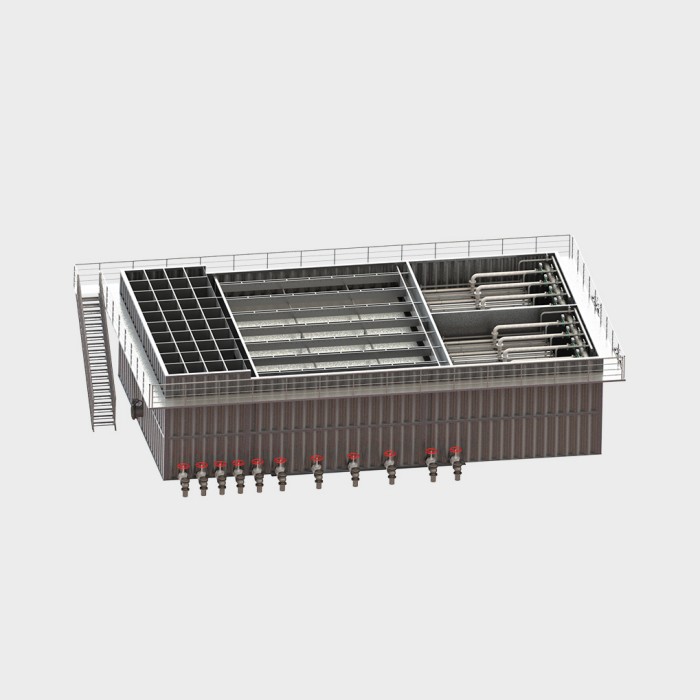
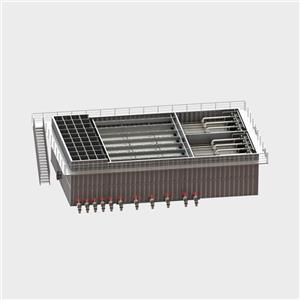
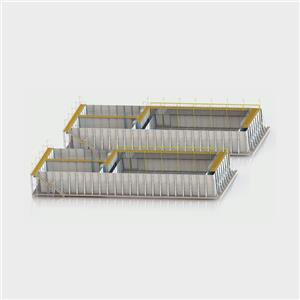
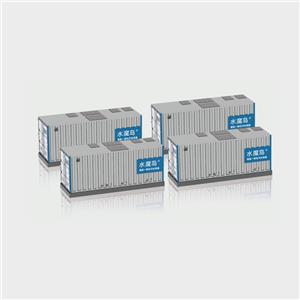
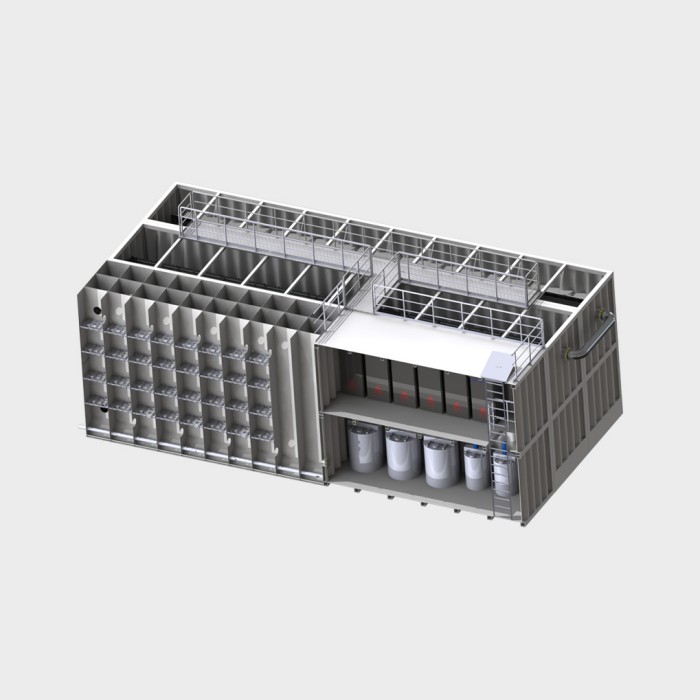
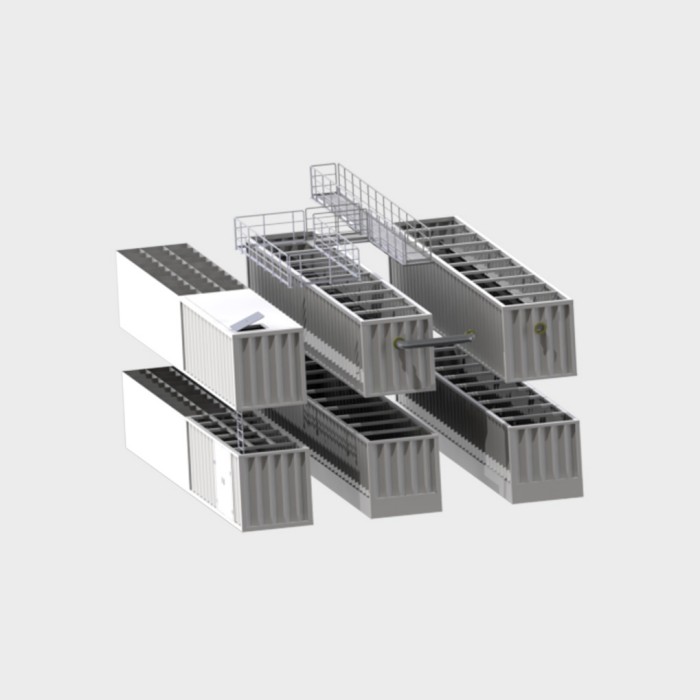
The product consists of water purification modules designed to comply with road transport dimensional limits. The majority of installation and quality inspection work is completed at the factory. Upon delivery to site, the modules are rapidly assembled using bolt connections — like building blocks — precisely addressing industry challenges and delivering a full-scenario solution that is quick to install, high in quality, and cost-effective.
For small to medium-sized water purification projects, the Modular Water Treatment Plant has proven to be comprehensively superior to traditional steel-reinforced concrete structures in terms of construction period, quality, investment, and green low-carbon performance.
Process Flow
Process Description
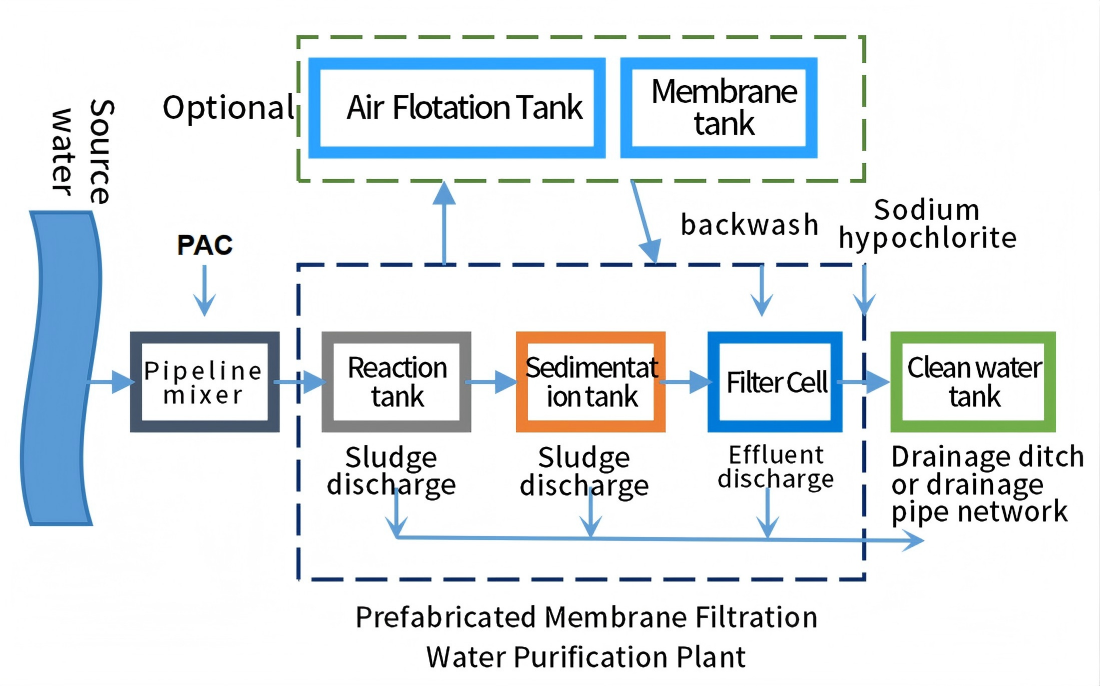
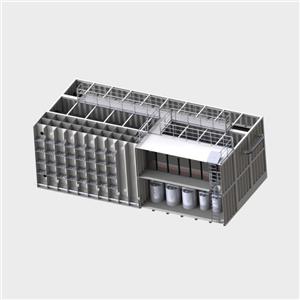
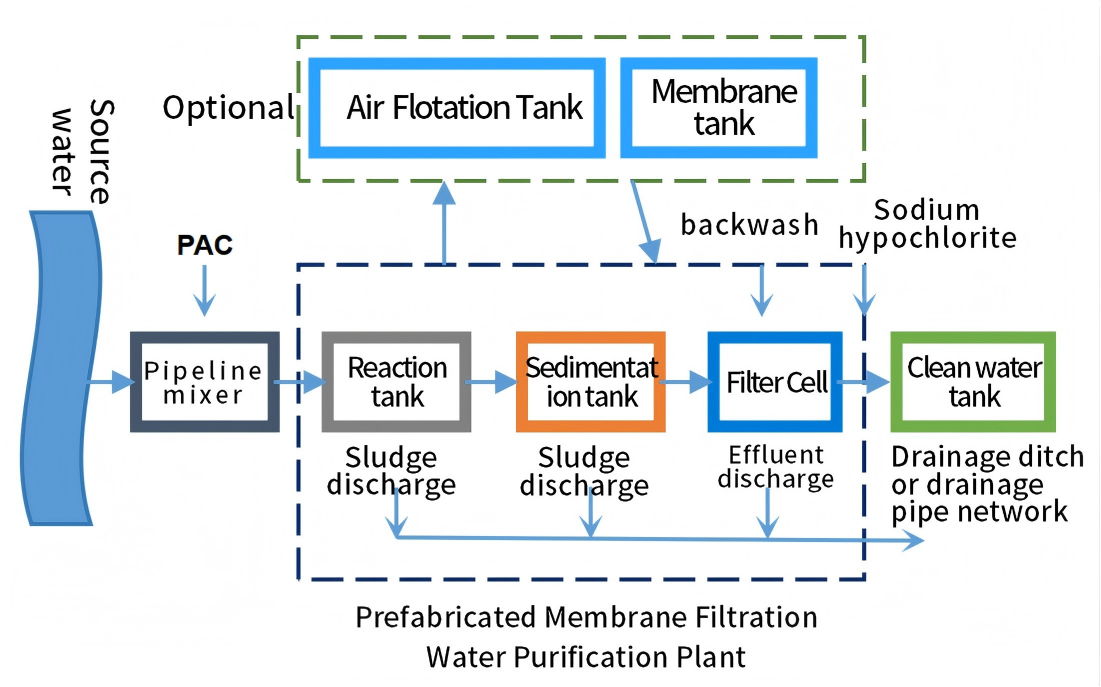
Coagulant is dosed into the raw water and mixed thoroughly via an in-line static mixer before entering the grid flocculation tank. As the flow expands and contracts through the grid baffles, the resulting turbulence promotes vigorous collision and aggregation of colloidal particles, forming dense, large flocs. The water then flows into the inclined tube sedimentation tank, where solid-liquid separation is rapidly achieved under the shallow-depth sedimentation principle. The supernatant is evenly distributed into the V-type filter, where physical retention and adsorptive filtration through the uniform filter media layer further remove suspended solids and trace colloidal particles. The filtered effluent is then disinfected by chlorine dosing, and upon meeting the required water quality standards, is delivered to the distribution network.
Key Features
Rapid on-site assembly
High equipment quality
Mature and stable process
Low investment cost
Fully automatic unattended operation
| Flow Rate (m³/h) | Product Dimensions (L × W × H / m) |
| 10 | 2 units of 3.5 × 2.438 × 2.591 (vertically stacked) |
| 20 | 2 units of 5.0 × 2.438 × 2.591 (vertically stacked) |
| 30 | 2 units of 6.5 × 2.438 × 2.591 (vertically stacked) |
| 50 | 2 units of 10.0 × 2.438 × 2.591 (vertically stacked) |
| 100 | 2 units of 18.0 × 2.438 × 2.591 (vertically stacked) |
| 220 | 6 units of 15.5 × 2.438 × 2.591 (vertically stacked) |
| 440 | 12 units of 15.5 × 2.438 × 2.591 (vertically stacked) |
| 660 | 18 units of 15.5 × 2.438 × 2.591 (vertically stacked) |
Note: The above series are standard configuration parameters. Actual dimensions are subject to the delivered equipment and can be customized based on specific customer requirements.
Core Advantages
Modular Design
Multiple optional sub-modules are available to ensure that each project can be flexibly configured according to specific water demand, construction, O&M, and investment requirements – delivering the most suitable water treatment solution for every client.
High Quality
All modules are manufactured in modern factories and undergo multiple quality inspection procedures before delivery. On-site installation requires only simple bolted connections – no welding needed. This ensures consistently high product quality.
Mature Process
The product adopts mature water purification processes including mixing, flocculation, sedimentation, filtration, and disinfection. Treated water quality consistently meets the requirements of the current national standard GB 5749-2022.
Fast Installation
On-site work is limited to simple bolted connections, reducing installation time to as little as 1 day. With virtually no welding required on site, no waste is generated – making the process green and low-carbon.
Permanent Structure
Zhongchang, in partnership with the China Institute of Building Standard Design & Research (CBS), has jointly established the "CBS–Zhongchang Innovation R&D Base for Prefabricated Water Plants", dedicated to innovating, developing, and designing modular water plant steel structures – creating a safe, low-consumption, and highly efficient steel structural system.
Digital & Intelligent Operation
The optional Zhongchang Smart Cloud Control System leverages digital twin process simulation and cloud-based expert model analysis to precisely control operating parameters. Combined with intelligent monitoring, it reduces costs, increases efficiency, and minimizes manual intervention. The system supports real-time data viewing, fault alerts, and remote adjustment of backwash cycles and chemical dosing rates via mobile APP or web interface.
Layout Options